





Mama Bear
3 weeks ago
★★★★★
The service was fantastic- courteous, knowledgeable and honest.Excerpt from Google review

Garage Door Problems
When a garage door reverses before closing, the opener usually sees a blocked or unstable sensor beam, mechanical resistance, or an incorrect travel endpoint. Clear and watch the sensors during movement, note where the reversal happens, and stop if the door binds or becomes crooked; do not increase force to push through it.
Safety references reviewed 2026-08-05.
LiftMaster, Chamberlain, Genie, Wayne Dalton, Clopay, and Amarr.
The door may reverse as soon as it starts down, stop halfway, or touch the floor and immediately travel back up. Opener lights may flash, a sensor LED may flicker, or the problem may happen only at a certain time of day.
What you're seeing
A reversal is a safety response, not a random choice. The opener may see a blocked or misaligned photo-eye beam, resistance from a binding door, an incorrect travel limit, or a safety-reversal test condition. Low sunlight can also interfere with the receiving sensor on some systems.
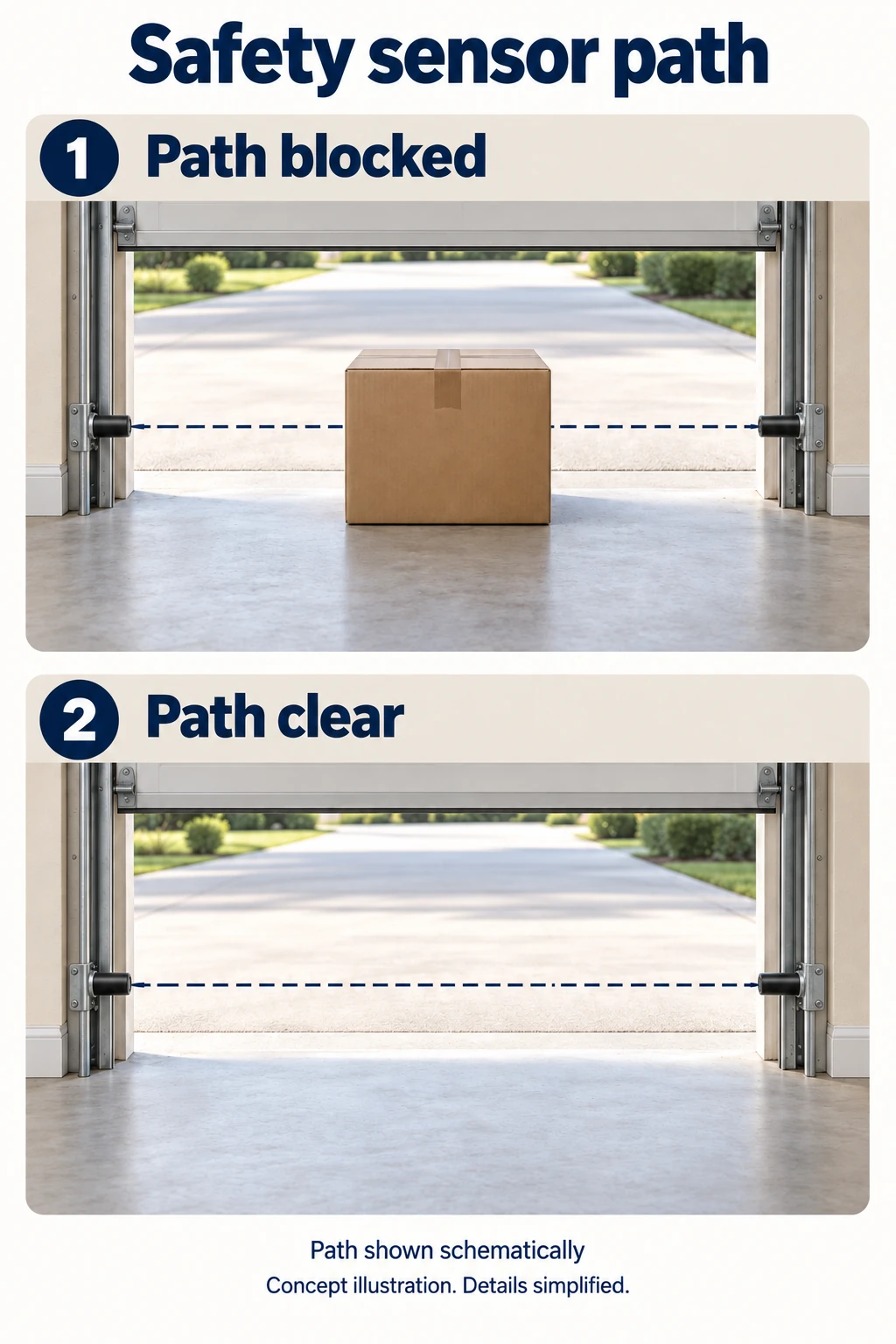
An object across the low sensor path can interrupt closing. The dashed path is schematic; the actual sensing beam is not visible. Reversal at the floor can have a different cause.
Select the image to enlargeHomeowner checks
Do not increase opener force to overpower a sticking door. Manufacturer guidance warns that force settings must not compensate for binding because excessive force can interfere with the safety-reversal system. Do not defeat or permanently bypass the photo-eyes.
The repair follows the pattern: align and test the sensors, inspect the sensor wiring, confirm smooth door travel by hand, then program travel or force only according to the opener's model-specific instructions. Any mechanical resistance is corrected before the opener is adjusted, and the safety-reversal system is tested afterward.
This is handled by our Garage Door Opener Repair service. Check availability for your ZIP and exact service address before scheduling.
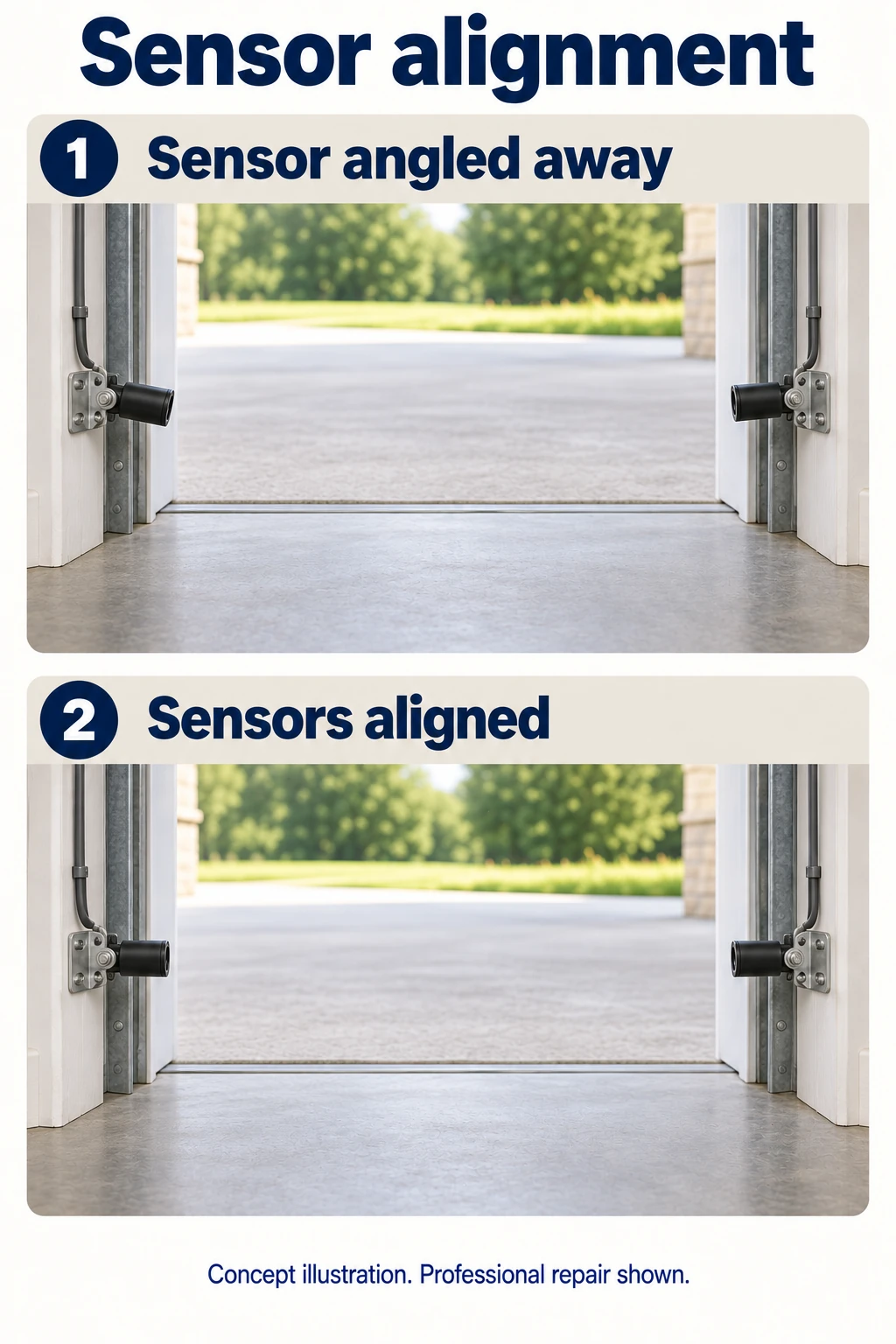
Clear space alone does not establish that the sensors work. Alignment, stable brackets, wiring and model-specific checks matter alongside the door's mechanical movement.
Select the image to enlargeNeed help with this symptom?
Call for current service availability, or send the symptom through the form so the request arrives with the correct problem context.
The opener may be seeing an interrupted photo-eye beam, unstable sensor wiring, mechanical resistance, or a travel endpoint that does not match the floor. The exact reversal point and sensor-light behavior separate those causes.
Low-angle sunlight can overwhelm the receiving photo-eye on some installations. The useful clue is a repeatable time of day plus a sensor light that changes when the sun reaches it.
The down-travel setting may be too long, the floor may be uneven, or the door may meet resistance at the bottom. The door and the model-specific travel setup should both be checked.
Not until the door is confirmed to move freely. More force can mask a binding door and weaken the protection provided by the reversal system.
A reversing opener is reporting a condition; the repair is finding which condition is real.
These references support the general safety guidance above. Your door and opener model instructions control for model-specific adjustments.
Where the door reverses matters: before reaching the floor, as it contacts the floor, or after appearing closed. A single “reopens” label hides these different observations.
Note whether the door approached an object or floor before going up. Do not place a body part or improvised object in its path to recreate a fault. Record a motor/sensor indication if visible from outside the travel area. Stop for damage, binding or uncontrolled movement.
A photo-eye interruption can affect closing. Floor contact and incorrect commanded travel are another category, while a damaged or binding door requires mechanical assessment. These possibilities can overlap; the guide cannot identify one from a short description. Increasing force to overcome reversal can hide the original problem.
The service proposal should identify the observed trigger and the relevant model instructions, not simply promise to turn up a setting. Ask what door-condition, travel and safety-system checks will be performed after the correction. If it closes and later opens as a separate event, use the unexpected-opening command inventory as well.
Genie describes sunlight interference with a Safe-T-Beam receiver. Note whether a previously observed closing problem occurred at the same time of day and which side was exposed, together with the indicator pattern. That correlation does not establish the cause on every brand. Do not bypass the beam or relocate or rewire sensors from a general article.
| Observation or choice | What it changes | What to record |
|---|---|---|
| Before floor contact | Beam/path or another fault may be involved | Position and indicator |
| At floor contact | Travel/interface or mechanical scope needs review | Whether floor/door work recently changed |
| After appearing fully closed | Confirm whether this is reversal or a new command | Delay and any app/control event |
| Damaged or binding | Stop operation rather than recreate it | Visible condition and current position |
Your record
Use information already observed safely, or supplied in writing. An empty field means the answer still needs confirmation.
Your notes are not sent or saved. Tool-use measurement records the action only, without your entries.
References: Genie: opener will not open or close · Genie: Safe-T-Beam sunlight interference
Editorial additions last reviewed October 4, 2026. Prepared with AI assistance, checked against the references below and revised after a separate AI review of factual scope and overlap. This is editorial guidance, not a technician inspection or a certification of your equipment.
Source check dates describe the review of the reference. They do not change a manual’s revision or establish current availability, price, compatibility or site suitability.
Check the exact equipment
A symptom does not identify the model or the failed part. Use the full model label to select documentation before applying model-specific advice.
Search all published brand and model guides. A missing result does not establish that a product is discontinued or unsupported.
One Request. Three Simple Steps.
No need to leave this page. You can change your answers at any step.
Your request is sent to Anderson. Appointment timing and any visit charge are confirmed with you.
Request submitted
Your request has been accepted for delivery to Anderson. A team member must confirm availability before any appointment is booked.
Need service now? Call (203) 902-3902 to confirm availability.
From our customers
3 weeks ago
The service was fantastic- courteous, knowledgeable and honest.Excerpt from Google review
a month ago
Very very professional guys good jobs good service
3 months ago
Great worker
3 months ago
They replaced three garage door motors for me, and the service was excellent from start to finish.Excerpt from Google review
4 months ago
Very good service and very polite
4 months ago
Very good work, polite and flexible in scheduling appointments.
Reviews from Google. Rating and relative dates checked October 1, 2026. This is a dated snapshot, not a live feed.
Serving your home with pride
Call now to discuss the problem and check availability for your ZIP. The exact service address is confirmed before scheduling.
AI assistant · General guidance and service requests