






The homeowner journal · Decision guide
Choosing the correct bottom-seal profile
Choose a bottom seal by the door’s retainer and required profile, not only its overall width or a picture of the rubber. Confirm the exact replacement with the door or component manufacturer before ordering.
Anderson Garage Door Service · Editorial review October 4, 2026
Choosing the correct bottom-seal profile
Choose a bottom seal by the door’s retainer and required profile, not only its overall width or a picture of the rubber. Confirm the exact replacement with the door or component manufacturer before ordering.
Identify the two parts of the fit
The flexible seal and the channel that holds it are separate pieces of the choice. A replacement that looks similar may have a different attaching edge. Record the door manufacturer and model if known, then use an existing accessible label or safe-distance photograph to identify the retainer. Do not remove a loaded bottom bracket or reach beneath an unstable door to get a sample.
Compare the attaching profile before the length
A T-end, bead or other profile needs the matching retainer geometry. Ask the supplier to show the actual profile drawing and the compatible door/retainer reference. Measure only an ordinary, safely accessible loose sample if one is already available; otherwise have the installer identify it. A wide rubber tube that can be squeezed into a slot is not proof of an approved fit.
Explain the sealing task
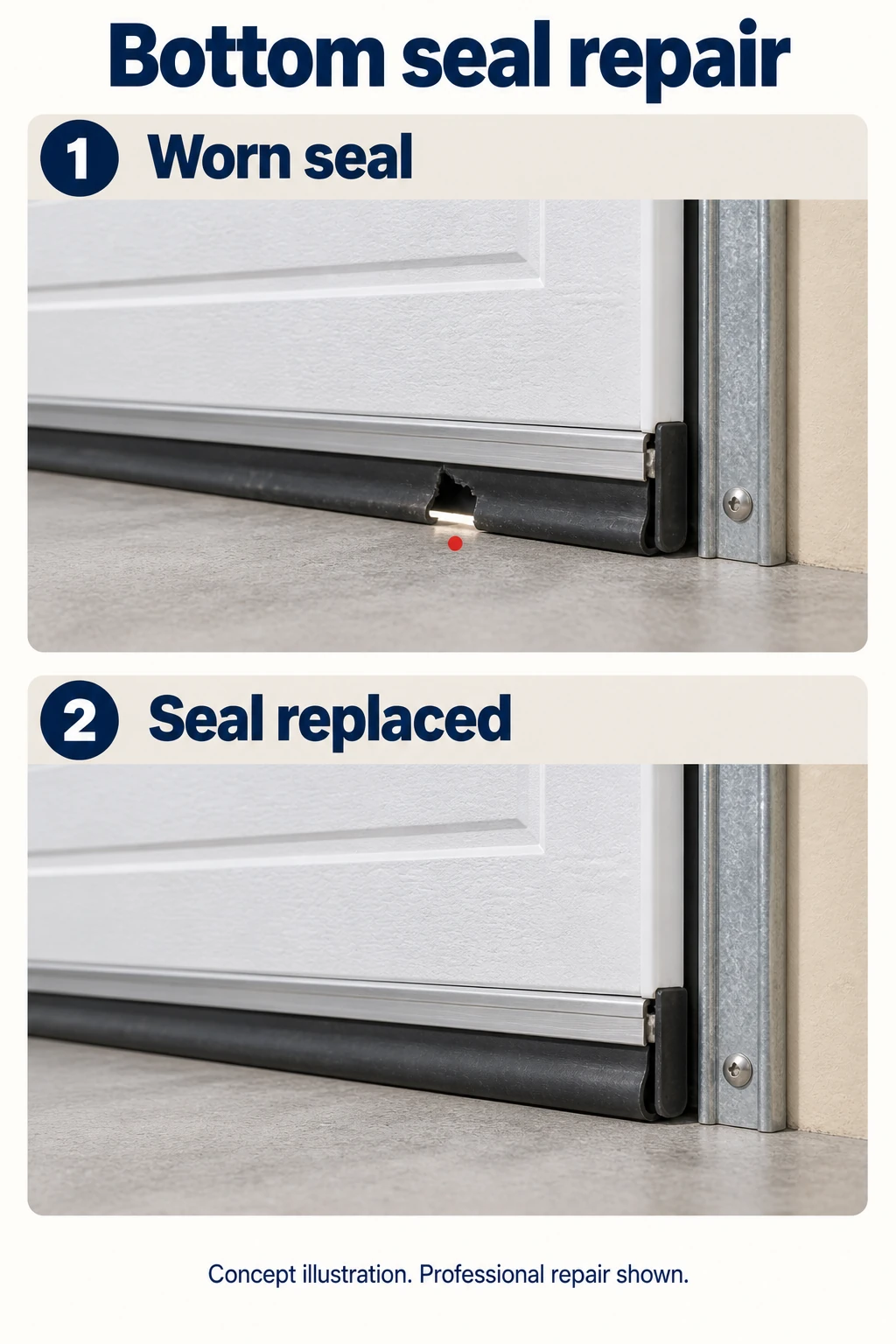
A brittle or torn seal is different from a floor gap, a tilted door or runoff toward the garage. Ask whether the quote replaces only the flexible component or also a damaged retainer, and whether a floor or drainage issue remains. Keep the profile, length, material, supplied fastening scope and exclusions together so the replacement can be checked at delivery.
Separate attachment shape from the flexible body
A T end or bead describes the edge that engages the retainer. A bulb describes the compressible body and can coexist with T attachments. Action’s Pro Super Seal is one such double-T profile with an internal tube; “bulb versus T” is therefore not a complete compatibility decision. Laid-flat width and installed height are different measurements. Use the supplier’s actual cross-section for the named item, not the proportions of this schematic.
| Observation or choice | What it changes | What to record |
|---|---|---|
| Door identity | Locates the relevant parts information | Manufacturer/model or clear label photo |
| Retainer profile | Determines the attaching-edge match | Drawing or confirmed part number |
| Flexible seal dimensions | Must match the intended component | Supplier specification, not a visual guess |
| Floor/contact issue | May require a different scope | Gap shape and water route |
| Item | Checked specification | Primary source |
|---|---|---|
| Action A2010 retainer | 0.25-inch channel for corresponding Action T-style seals | Action A2010 bottom-seal retainer |
| Action Pro Super Seal | Double 1/4-inch T ends; 4.20 inches laid flat versus 1.90 inches installed | Action Pro Super Seal T-style profile |
| Action V3564-00-W | 4-inch bead-end catalog item; listed for Wayne Dalton 8000/9000 families | Action bead-end bottom-seal catalog |
These examples identify interfaces, not interchangeable parts. Confirm the actual door revision, retainer drawing, attachment dimensions and required length with the supplier. The bead dimension is not established by the catalog title.
Your record
Bottom-seal ordering record
Use information already observed safely, or supplied in writing. An empty field means the answer still needs confirmation.
Your notes are not sent or saved. Tool-use measurement records the action only, without your entries.
References: Clopay: garage-door seal types · Clopay: service and replacement components · Action A2010 bottom-seal retainer · Action Pro Super Seal T-style profile · Action bead-end bottom-seal catalog
Discuss the scope for your actual door
Keep observations and open questions with the written proposal. The provider must assess the actual system and confirm service availability for your address.
Garage Door Repair: scope and next steps →Sources & editorial review
Editorial additions last reviewed October 4, 2026. Prepared with AI assistance, checked against the references below and revised after a separate AI review of factual scope and overlap. This is editorial guidance, not a technician inspection or a certification of your equipment.
Source check dates describe the review of the reference. They do not change a manual’s revision or establish current availability, price, compatibility or site suitability.
- Clopay: garage-door seal types — checked 2026-10-03. Distinguishes lower-edge, threshold and perimeter locations; select actual profiles and interface.
- Clopay: service and replacement components — checked 2026-10-03. Component-specific support and professional track/hinge repair scope. No universal substitutions asserted.
- Action A2010 bottom-seal retainer — checked 2026-10-04. Named retainer has a 0.25-inch channel for corresponding Action T-style seals. No universal door fit or fastening recipe.
- Action Pro Super Seal T-style profile — checked 2026-10-04. Double 1/4-inch T attachment; 4.20-inch laid-flat and 1.90-inch installed dimensions are distinct. Conflicting material wording is not used.
- Action bead-end bottom-seal catalog — checked 2026-10-04. V3564-00-W is a 4-inch bead-end item with a named Wayne Dalton family application. Actual bead dimensions and door revision still require supplier confirmation.