






The homeowner journal · Decision guide
Read and compare garage-door product specifications
Compare the same configured door, not just two brochure headlines. Keep model/options, dimensions, test scope and package inclusions aligned before deciding that one specification is better.
Anderson Garage Door Service · Editorial review October 4, 2026
Read and compare garage-door product specifications
Compare the same configured door, not just two brochure headlines. Keep model/options, dimensions, test scope and package inclusions aligned before deciding that one specification is better.
Identify the exact configuration behind each number
A product family can have more than one construction, window package or finish. Record the model/series and chosen options with the brochure revision or current product page. Do not treat the highest number advertised for a family as the figure for every configuration.
Put different kinds of claims in different rows
Dimensions, construction, thermal performance, glazing and written coverage answer different questions. R-value and U-factor are not interchangeable, and a section value does not automatically represent a whole configured assembly. Link to the existing thermal-rating guide for the explanation rather than comparing unlike test scopes in one “insulation” cell.
Separate a specification from an installed promise
A brochure cannot confirm that a product fits the measured opening or that a quoted installer includes the required track, removal and setup. Ask the supplier to mark unknown fields and the installer to confirm fit and scope. A blank supported field is more honest than filling in an industry-looking number from a different product.
Worked comparison: two Classic Steel short-panel constructions
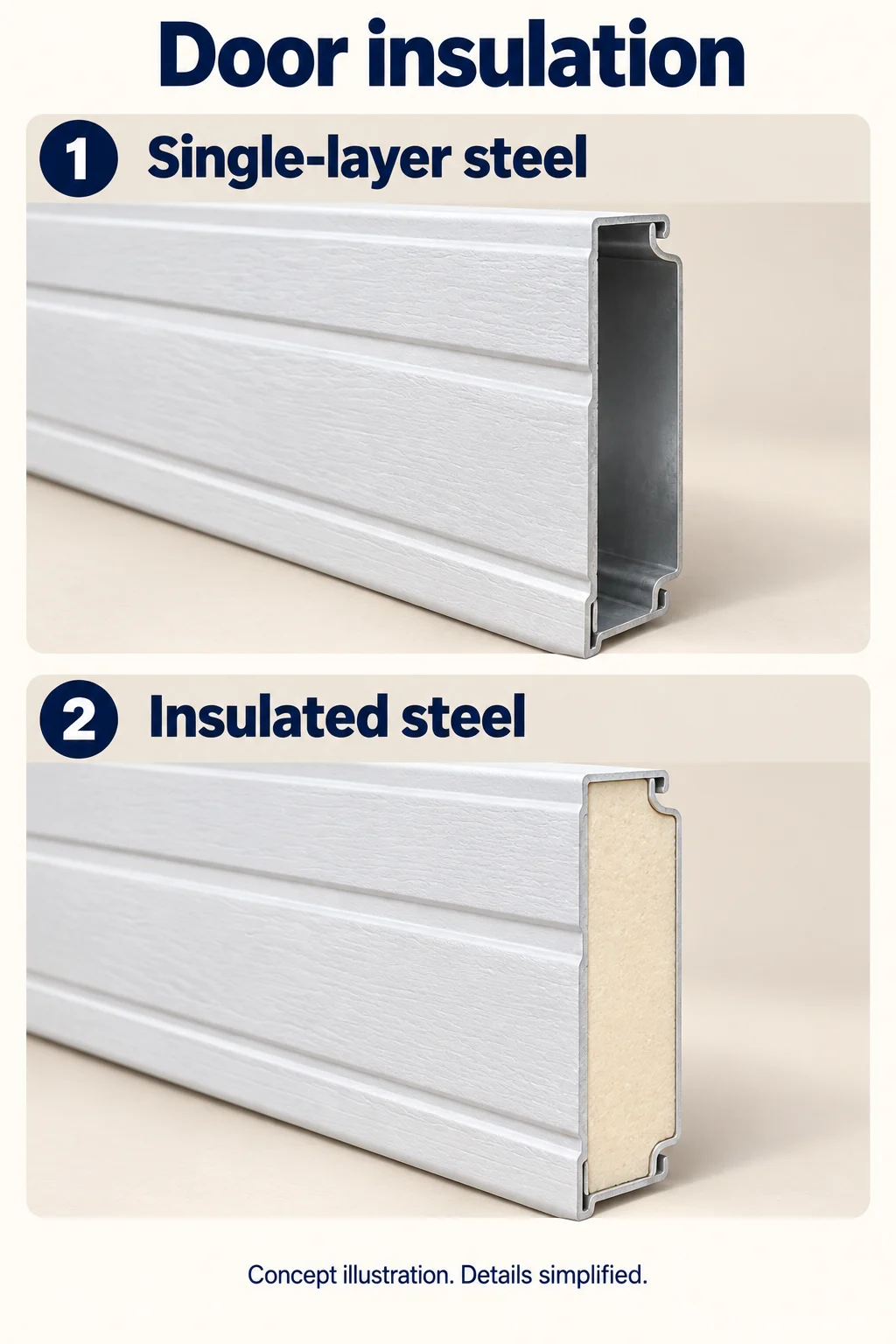
Clopay’s Classic Steel brochure separates 9200 polyurethane and 4300 bonded-polystyrene short-panel models. The table below compares their two-inch solid-section construction using the baseline steel gauge, excluding Black and Ultra-Grain finish options. Each figure comes from brochure page 3, including its section-R-value footnote. Opening size, selected finish/glazing, complete thermal test result, site fit, current written coverage and installed quote still need confirmation.
| Observation or choice | What it changes | What to record |
|---|---|---|
| Model/options | Defines the product being compared | Exact series and selected configuration |
| Dimensions/clearances | Need site and system confirmation | Product document plus measured opening |
| Thermal rating | Compare like test scopes | Metric, configuration and test reference |
| Windows/construction | Options can change the assembly | Chosen glazing/material |
| Package/coverage | Not every brochure feature is a quoted inclusion | Written package and current terms |
| Specification | 9200 short panel | 4300 short panel | Primary source |
|---|---|---|---|
| Section construction | Steel / polyurethane / steel | Steel / bonded polystyrene / steel | Clopay Classic Steel brochure, page 3 |
| Section thickness | 2 inches | 2 inches | Clopay Classic Steel brochure, page 3 |
| Baseline steel gauge | 27; named Black/Ultra-Grain options use 25 | 27; named Black/Ultra-Grain options use 25 | Clopay Classic Steel brochure, page 3 |
| Calculated section R-value | 18.4 | 9.0 | Clopay Classic Steel brochure, page 3 |
| Thermal scope | Door-section value, DASMA TDS-163 | Door-section value, DASMA TDS-163 | Clopay Classic Steel brochure, page 3 |
| Fit, quoted package and price | Not established by this table | Not established by this table | Clopay Classic Steel brochure, page 3 |
This is a source-backed construction comparison, not two approved site orders. Confirm selected dimensions and options before turning it into a purchasing comparison; do not infer whole-door U-factor or energy savings.
Your record
Configured-product comparison
Use information already observed safely, or supplied in writing. An empty field means the answer still needs confirmation.
| Comparison item | Product A | Product B |
|---|---|---|
| Exact model and selected options | ||
| Current specification source/revision | ||
| Configured dimensions and site fit | ||
| Construction and glazing | ||
| Thermal metric, configuration and test scope | ||
| Included hardware and installation | ||
| Current written coverage | ||
| Unknown or unsupported fields |
Your notes are not sent or saved. Tool-use measurement records the action only, without your entries.
References: Clopay: garage-door product FAQs · DASMA: R-value and U-factor · Clopay Classic Steel brochure, page 3
Discuss the scope for your actual door
Keep observations and open questions with the written proposal. The provider must assess the actual system and confirm service availability for your address.
Garage Door Installation & Replacement: scope and next steps →Sources & editorial review
Editorial additions last reviewed October 4, 2026. Prepared with AI assistance, checked against the references below and revised after a separate AI review of factual scope and overlap. This is editorial guidance, not a technician inspection or a certification of your equipment.
Source check dates describe the review of the reference. They do not change a manual’s revision or establish current availability, price, compatibility or site suitability.
- Clopay: garage-door product FAQs — checked 2026-10-03. Configured products and matching door packages; availability is not generalized from the FAQ.
- DASMA: R-value and U-factor — checked 2026-10-03. Separate section/material metrics from whole-door test scope; no saving or temperature forecast.
- Clopay Classic Steel brochure, page 3 — checked 2026-10-04. 9200 and 4300 short-panel constructions, section R-values and option-dependent steel gauge. Section R-value is calculated under DASMA TDS-163; fit and installed price remain unknown.