





FIELD GUIDE 01 / Know your door
A little knowledge. A much clearer picture of your garage door.
Learn what garage door springs, tracks, rollers and openers actually do, with an illustrated overview and a practical guide to describing a problem.
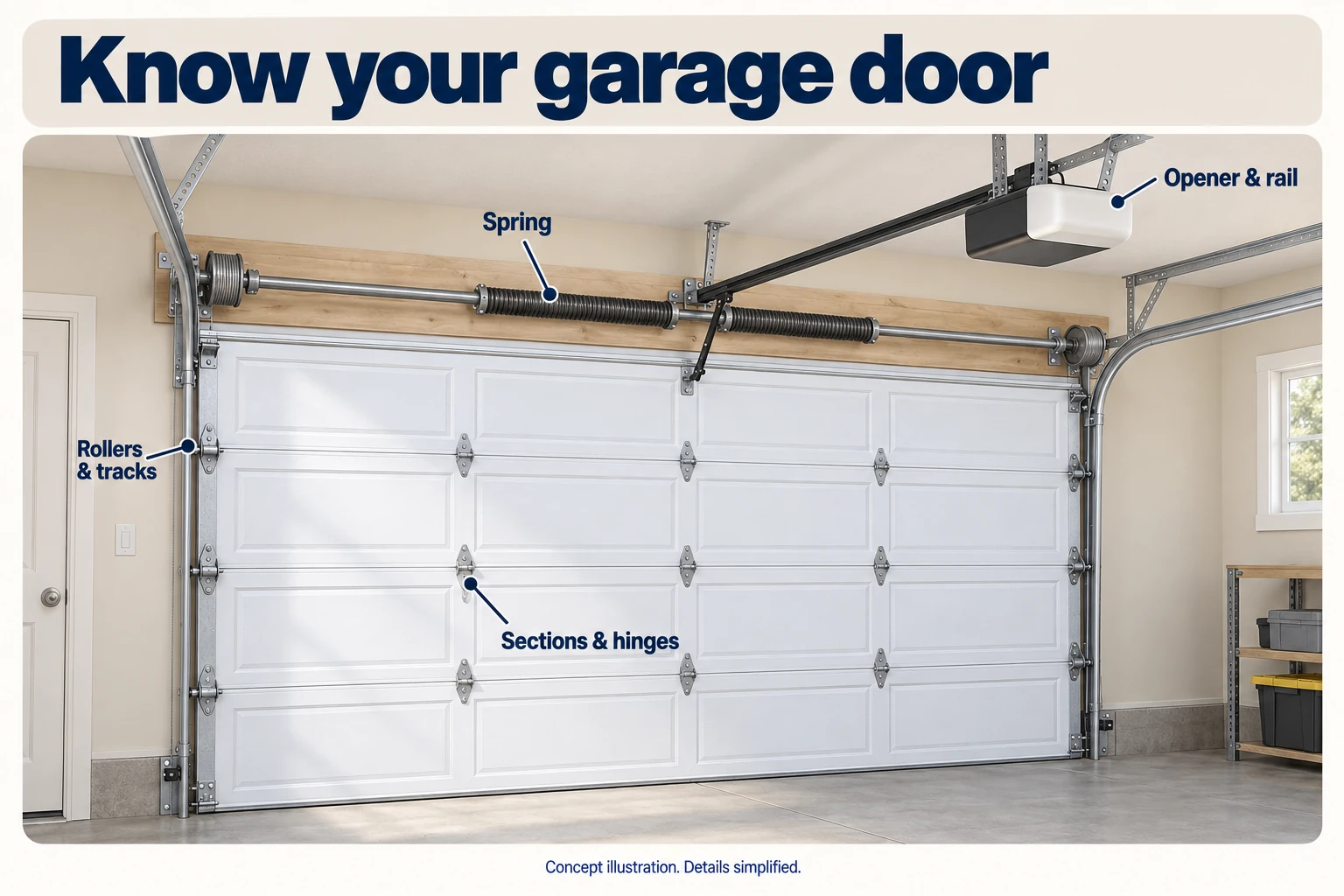
When a garage door stops working, everything above the car can look like one complicated machine. Learning a few names makes the next conversation much easier. This guide follows a common sectional door from the panels you can see to the hardware around them. Your own door may use a different spring or opener arrangement.
The springs counterbalance the door. The opener controls its movement. They have different jobs.
A CLOSER LOOK
Meet the moving parts
Open a part name to see its role. Use this as a vocabulary guide, not a repair checklist.
01Sections & hinges
Horizontal sections form the door face. Hinges connect neighboring sections so they can follow the curved path overhead. A section is part of the door; the opener is a separate device.
References: Clopay — garage door components
02Rollers & tracks
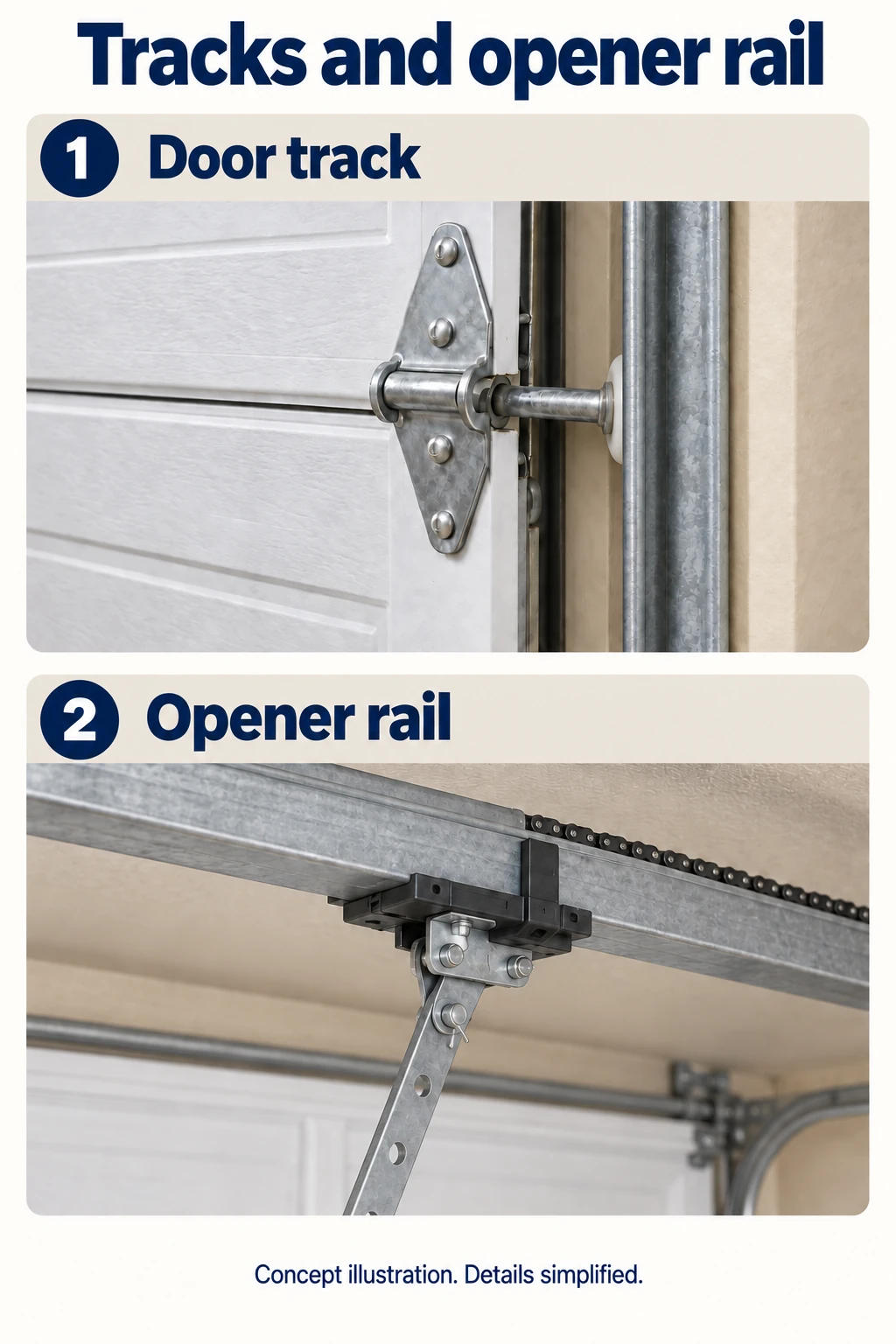
Rollers travel in tracks on both sides. On a typical standard-lift system, the tracks curve from vertical to horizontal. The track guides the door; it is not the opener's center rail.
References: Genie — garage door components and maintenance
03Springs
Springs counterbalance the door's weight. The illustration shows torsion springs above the opening. Other doors use extension springs alongside the overhead tracks. Neither arrangement is a homeowner adjustment point.
References: Genie — garage door components and maintenance · DASMA — garage door system safety
04Cables, drums & bottom brackets
In a torsion system, lift cables connect the bottom brackets to drums on the shaft. These are loaded components. Do not loosen a bottom bracket, reposition a cable or try to unwind a spring.
References: Genie — garage door components and maintenance · DASMA — garage door system safety
05Opener & center rail
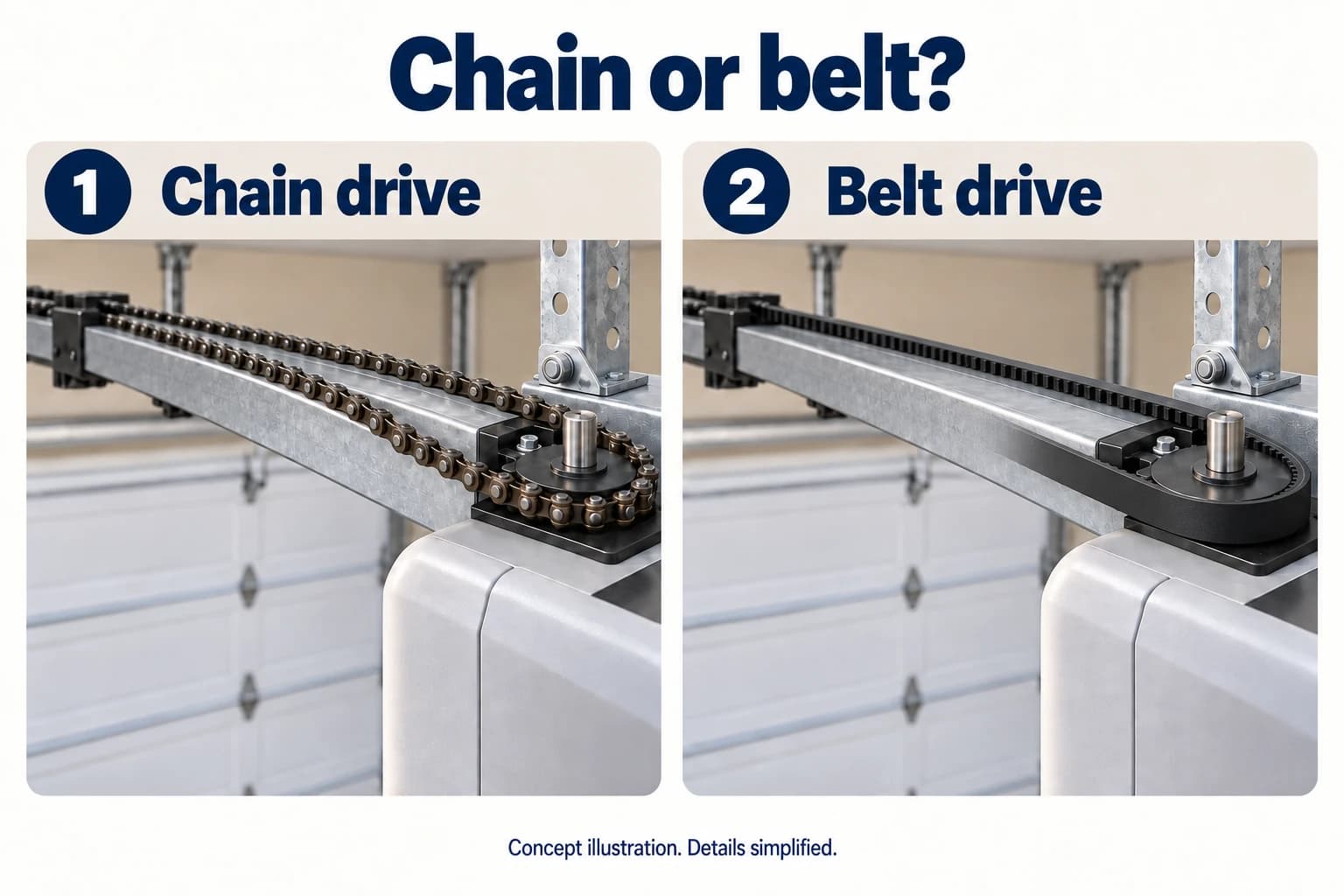
A ceiling opener moves a carriage along a rail connected to the door. A wall-mounted opener uses a different arrangement. A larger motor is not a repair for a damaged counterbalance system.
References: Genie — garage door components and maintenance · DASMA — garage door system safety
06Weather seals
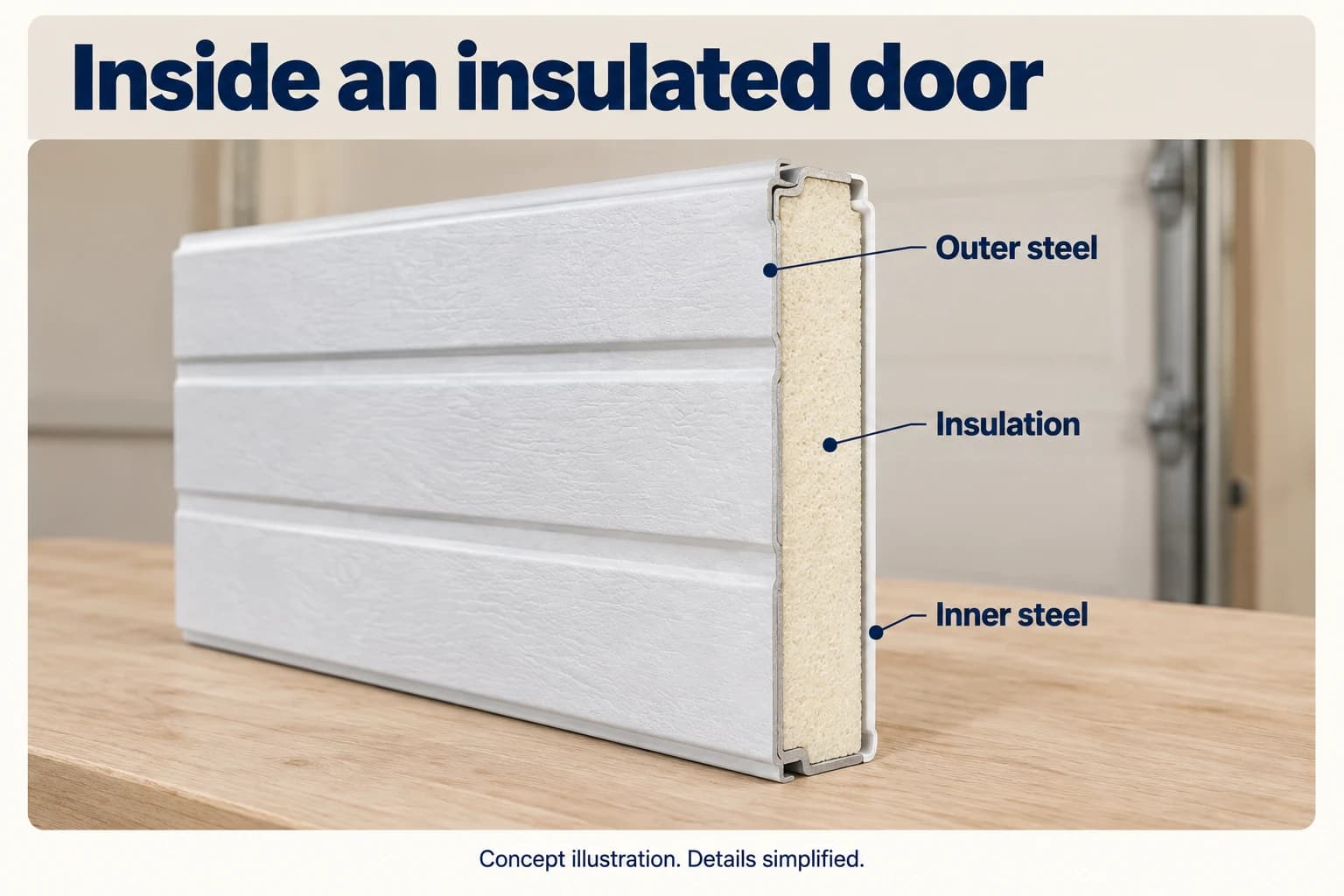
The bottom and perimeter seals help close gaps around the opening. A weather seal is different from the insulation inside a door section: one addresses the edge, the other the panel construction.
References: Clopay — garage door components
Describe the behavior before naming the repair
A useful service request starts with what happened: the door stopped a few inches from the floor, one side looked lower, or the opener made a sound while the door stayed still. That description is more useful than guessing that the motor has failed.
Our suggested note has four parts: what you asked the door to do, what actually moved, where it stopped, and anything unusual you noticed. Record what you already observed; do not cycle a damaged door again just to collect more details.
Two tracks, one center rail, different functions
The rails beside the door guide its rollers. The center rail of a ceiling-mounted opener carries its drive mechanism. Mixing up those names can lead to a confusing description of a loose or noisy part. When speaking to a technician, adding a location—left edge, above the opening, or center of the ceiling—can be more helpful than knowing the perfect term.
References: Genie — garage door components and maintenance
Where observation should stop
A frayed cable, an uneven door or a damaged spring calls for professional attention. Keep clear of the opening and stop using the system. Do not loosen loaded hardware or pull an manual release beneath an unstable raised door. Follow the door and opener manuals for your exact equipment.
This illustrated guide helps you recognize components. It does not establish whether a particular door is balanced or safe to operate. Those judgments require an inspection of the actual system.
References: DASMA — garage door system safety
TAKE THIS WITH YOU
Make your next service conversation easier
- Write down the behavior you already observed.
- Note the door and opener brands if their labels are safely visible.
- Identify the location using plain words: left, right, overhead or center.
- Keep people away if the door is uneven, unstable or has damaged cables.
Sources & illustration notes
Manufacturer and industry references checked September 9, 2026. The explanations and comparison checklists are editorial guidance, not a product test or an inspection of your door.
- Clopay — garage door components ↗
- Genie — garage door components and maintenance ↗
- DASMA — garage door system safety ↗
The original artwork was generated with AI for this guide. It illustrates concepts and omits or simplifies hardware. It is not a photograph of an Anderson installation or a model-specific service diagram.
KEEP EXPLORING