





Mama Bear
3 weeks ago
★★★★★
The service was fantastic- courteous, knowledgeable and honest.Excerpt from Google review

Garage Door Problems
The remote works from inside the garage but not the driveway, works only when held near the door, fails when the opener light is on, or needs several presses. The wired wall control may continue to operate normally.
Safety references reviewed 2026-07-24.
LiftMaster, Chamberlain, Genie, Wayne Dalton, Clopay, and Amarr.
The remote works from inside the garage but not the driveway, works only when held near the door, fails when the opener light is on, or needs several presses. The wired wall control may continue to operate normally.
What you're seeing
Remote range depends on battery condition, correct programming, the opener antenna, radio interference, and the building around the receiver. Some LED or CFL bulbs and other electrical devices can radiate interference. Metal doors, siding, and multiple nearby openers can also reduce range. If all transmitters fail similarly, the receiver or antenna path becomes more likely.
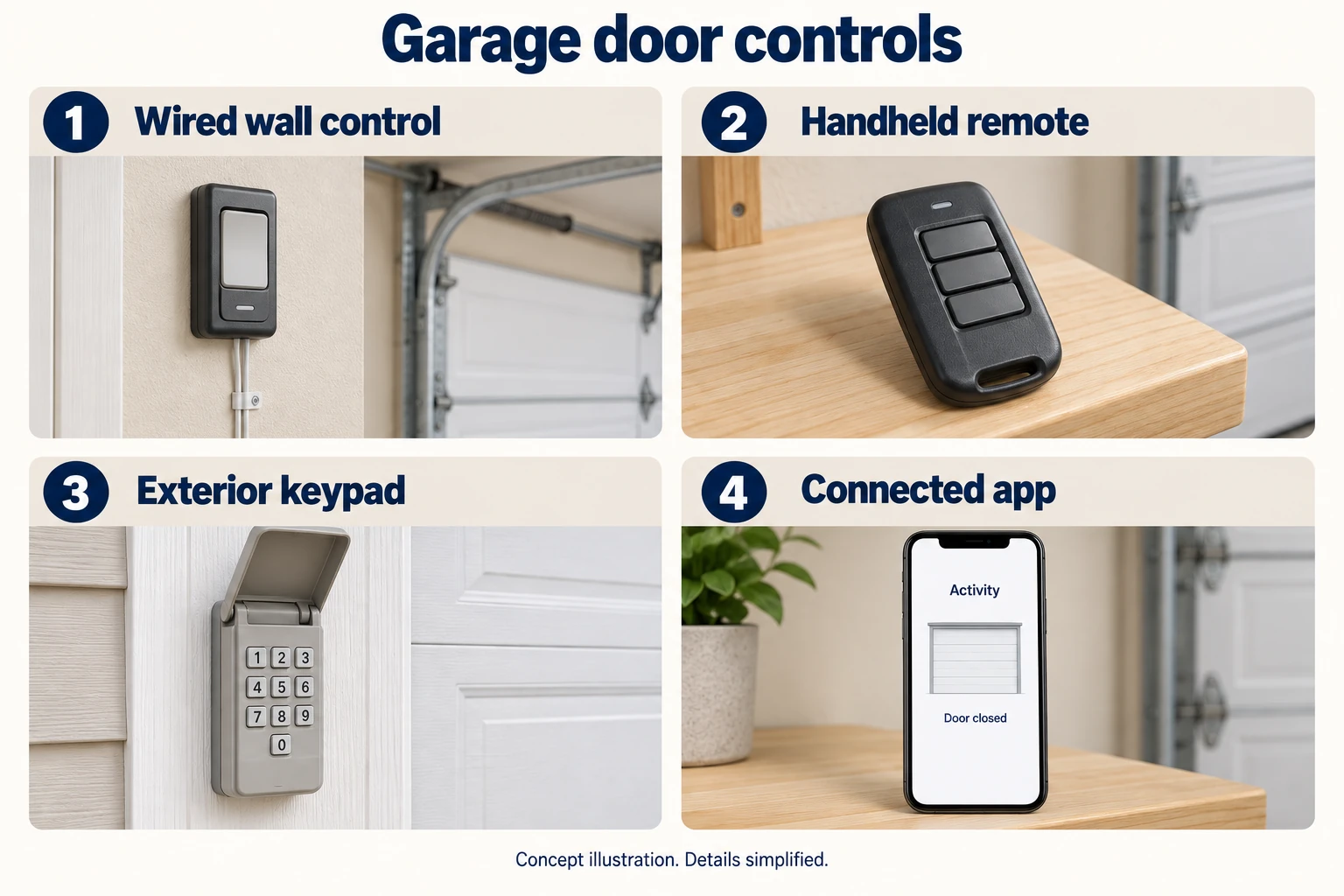
Compare which controls work. A wired wall button uses a different path from a handheld remote or wireless keypad; this comparison helps narrow the diagnosis.
Select the image to enlargeHomeowner checks
Keep the door in sight whenever operating it and keep transmitters away from children. Do not repeatedly press a remote while approaching a door you cannot see. Disconnect power before any work inside the opener housing.
The repair confirms transmitter compatibility and programming, tests batteries and range, removes interference sources, inspects the antenna, and compares multiple controls. If the signal path remains weak, the receiver, logic board, or an approved external antenna solution is evaluated for that opener model.
This is handled by our Garage Door Opener Repair service. Check availability for your ZIP and exact service address before scheduling.
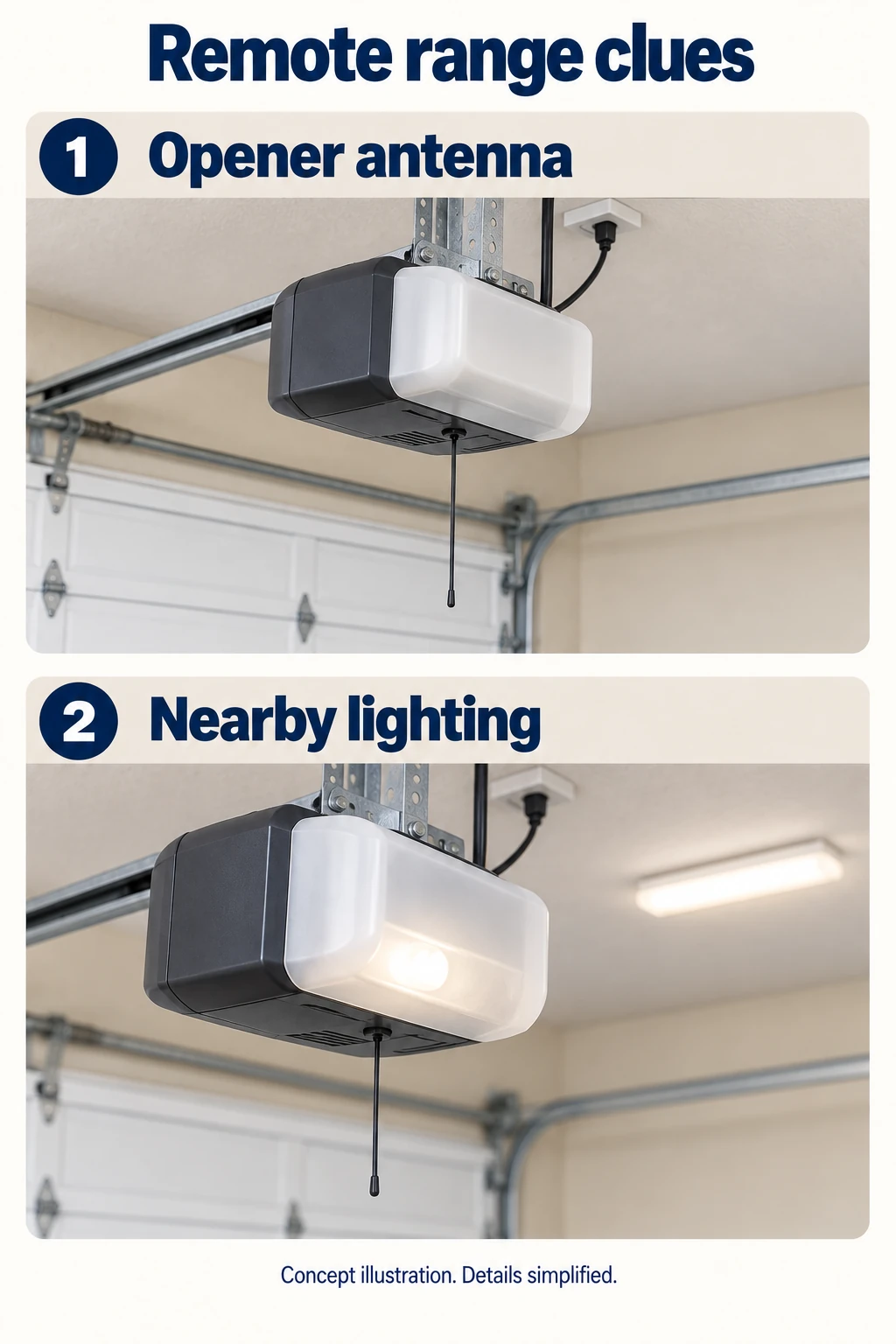
The antenna and nearby lighting are two places to investigate when range changes. Some LED bulbs can interfere with radio reception; bulb compatibility and antenna details depend on the opener model.
Select the image to enlargeNeed help with this symptom?
Call for current service availability, or send the symptom through the form so the request arrives with the correct problem context.
Some bulbs and drivers can emit radio noise that reduces range. Compare remote operation with the opener light on and off. If the manual permits a bulb-removal test, disconnect electrical and backup-battery power before handling bulbs, let them cool, and reassemble the lamp area before restoring power.
A metal door or surrounding construction can attenuate the signal more when the door is closed. Antenna position and approved extension options may matter.
Not first. Test battery, range, antenna, interference, and another control. Erasing memory can disable every programmed remote and keypad without fixing the cause.
A bulb or LED driver can create radio interference while lit. Chamberlain also identifies the wall control or logic board as possible causes on some systems. Compare light-on and light-off behavior first; handle bulbs only with electrical and backup-battery power disconnected according to the manual.
Intermittent range is easiest to solve by changing one radio condition at a time.
These references support the general safety guidance above. Your door and opener model instructions control for model-specific adjustments.
Compare controls, location and lamp state before buying a receiver or opener. An intermittent remote response can have more than one cause, and a single successful press is not a complete test.
Record which remote was involved, where it was used and whether the opener lamp was on. Include the date and any recent bulb, battery or device change. Genie documents radio-frequency interference as a possible contributor to reduced range; this does not establish that a nearby router or a particular bulb caused this fault.
If one authorized remote works reliably and another does not in the same existing conditions, keep that distinction. It is useful evidence for device power, programming or compatibility review. If several controls share the symptom, the opener receiver or surrounding environment may also need attention. Do not repeatedly cycle an unsafe door just to compare devices.
Identify the opener and remote model before ordering. Frequency alone is insufficient because control protocol and supported generation also matter. If replacement is proposed, ask the supplier for the exact manufacturer compatibility reference. Use the remote-replacement guide when you are ready to compare a supported replacement.
Use a simple plan of the driveway and garage to record the remote’s location: in front, to the left, to the right or already inside. Add approximate distance only if known; do not turn the map into a promised operating radius. Mark existing successful and failed events rather than repeatedly moving the door to build a survey.
If the change followed a new vehicle, record already observed events with it parked nearby versus away; note obstructions and any antenna information supplied by the model manual. Do not move a damaged door to create a test. For a battery change, check the exact remote manual’s battery type and polarity, note any visible damage in an ordinary accessible battery compartment, and confirm the pairing status using that remote’s supported instructions. Do not scrape, bridge or repair contacts, reposition an antenna or clear all receiver controls from this guide.
If already observed safely, note whether the same remote responded differently while the door was open versus closed. A metal door can change the radio path, but this comparison alone cannot diagnose attenuation. When a correctly specified fresh battery has not resolved the symptom, record the battery type, installation date and indicator response, then have programming, compatibility, the device and receiver assessed. Do not treat “new battery” as proof that the remote is good.
| Observation or choice | What it changes | What to record |
|---|---|---|
| One remote fails, another works | Compare device-specific conditions | Model and battery/programming history |
| Both fail at the same time | A shared receiver/environment issue remains possible | Wall-control response and timing |
| Only at distance | Range/interference or device condition needs review | Location, not an invented expected range |
| After a lamp change | Record the correlation for the installer | Lamp model and on/off state |
Your record
Use information already observed safely, or supplied in writing. An empty field means the answer still needs confirmation.
Your notes are not sent or saved. Tool-use measurement records the action only, without your entries.
References: Genie: remote range and radio interference · Genie: universal remote instructions
Editorial additions last reviewed October 4, 2026. Prepared with AI assistance, checked against the references below and revised after a separate AI review of factual scope and overlap. This is editorial guidance, not a technician inspection or a certification of your equipment.
Source check dates describe the review of the reference. They do not change a manual’s revision or establish current availability, price, compatibility or site suitability.
Check the exact equipment
A symptom does not identify the model or the failed part. Use the full model label to select documentation before applying model-specific advice.
Search all published brand and model guides. A missing result does not establish that a product is discontinued or unsupported.
One Request. Three Simple Steps.
No need to leave this page. You can change your answers at any step.
Your request is sent to Anderson. Appointment timing and any visit charge are confirmed with you.
Request submitted
Your request has been accepted for delivery to Anderson. A team member must confirm availability before any appointment is booked.
Need service now? Call (203) 902-3902 to confirm availability.
From our customers
3 weeks ago
The service was fantastic- courteous, knowledgeable and honest.Excerpt from Google review
a month ago
Very very professional guys good jobs good service
3 months ago
Great worker
3 months ago
They replaced three garage door motors for me, and the service was excellent from start to finish.Excerpt from Google review
4 months ago
Very good service and very polite
4 months ago
Very good work, polite and flexible in scheduling appointments.
Reviews from Google. Rating and relative dates checked October 1, 2026. This is a dated snapshot, not a live feed.
Serving your home with pride
Call now to discuss the problem and check availability for your ZIP. The exact service address is confirmed before scheduling.
AI assistant · General guidance and service requests